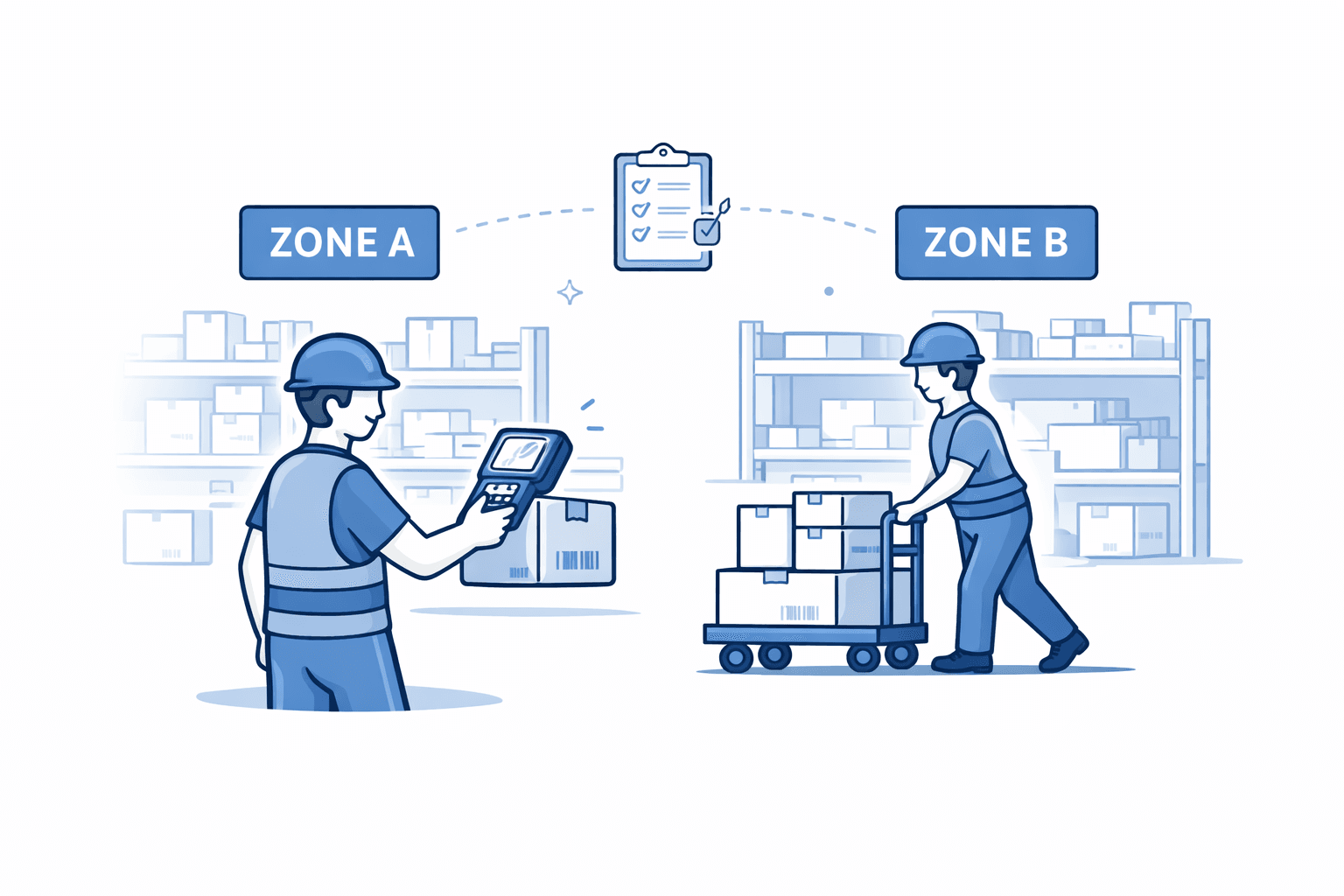

Zone Picking is one of the most widely used order picking methods in modern warehouses. Instead of allowing every picker to travel throughout the entire warehouse, the warehouse is divided into multiple zones, and each picker is responsible for collecting products only within a designated area. This approach significantly reduces travel time while improving productivity and scalability.
As order volumes continue to grow, especially in e-commerce and third-party logistics (3PL), many warehouses adopt Zone Picking to improve fulfillment efficiency without dramatically increasing labor costs.
This article explains what Zone Picking is, why it is used, its key features, its advantages, common warehouse scenarios, and why it is an important capability in a modern Warehouse Management System (WMS).
What Is Zone Picking?
Zone Picking is an order picking strategy that divides a warehouse into multiple physical or logical zones. Each warehouse associate is assigned to one or more zones and only picks the items located within those areas.
When a customer order contains products from several zones, multiple pickers participate in fulfilling the same order. After every zone has completed its assigned picks, the items are consolidated before packing and shipping.
Unlike traditional discrete picking, where one employee may travel across the entire warehouse, Zone Picking distributes the workload among multiple workers while minimizing unnecessary movement.
Why Is Zone Picking Used?
Zone Picking is designed to improve warehouse efficiency by organizing work according to warehouse layout and inventory distribution.
1. Reduce Picker Travel Time
Walking is one of the largest sources of wasted labor inside a warehouse. By limiting employees to specific zones, travel distance is significantly reduced, allowing workers to spend more time picking products instead of walking between aisles.
2. Increase Picking Productivity
Employees become familiar with the products, storage locations, and traffic patterns within their assigned zones. This familiarity enables faster picking and reduces the time required to locate inventory.
3. Improve Warehouse Scalability
As order volume grows, additional workers can be assigned to busy zones without redesigning the entire picking process. This makes Zone Picking particularly effective for seasonal demand and business growth.
4. Balance Workloads
Warehouse managers can divide zones based on SKU count, order frequency, or workload. Busy areas can receive additional labor while quieter zones require fewer employees, improving overall operational balance.
Key Features of Zone Picking
Zone Picking includes several characteristics that distinguish it from other picking strategies.
1. Dedicated Picking Zones
The warehouse is divided into clearly defined areas based on aisles, product families, temperature requirements, or operational needs. Each picker is responsible for only one or several assigned zones.
2. Multiple Pickers Can Fulfill One Order
A single customer order may require products from multiple warehouse zones. Different employees pick their respective items before the order is consolidated into a complete shipment.
3. Order Consolidation
Because products are picked independently in different zones, warehouses require a consolidation process to combine all picked items before packing. This can be performed manually or automatically through conveyor systems or sortation equipment.
4. Flexible Zone Assignment
Warehouse managers can temporarily adjust zone boundaries or assign additional staff during peak seasons to improve throughput and reduce bottlenecks.
5. WMS Coordination
A modern Warehouse Management System (WMS) automatically routes picking tasks to the correct zones, tracks order progress, coordinates consolidation, and helps optimize labor utilization across the warehouse.
Advantages of Zone Picking
Zone Picking offers several operational benefits that make it one of the most popular picking methods for medium and large warehouses.
Higher Productivity
Reducing travel distance allows employees to complete more picks per hour, increasing overall warehouse throughput.
Better Picking Accuracy
Workers become experts within their assigned areas, making it easier to locate products correctly and reducing picking mistakes.
Improved Labor Efficiency
Managers can allocate labor resources according to workload, minimizing idle time while improving operational flexibility.
Easier Training
New employees only need to learn the products and storage locations within a limited area instead of understanding the entire warehouse.
Better Scalability
As warehouses expand, additional zones can be created without changing the overall picking strategy, making operations easier to scale.
Common Zone Picking Scenarios in Warehousing and Logistics
Zone Picking is commonly used in warehouses with large inventories, high order volumes, or complex warehouse layouts.
E-commerce Fulfillment Centers
Online retailers often process thousands of small orders every day. Zone Picking helps reduce travel distance and supports fast order fulfillment during peak shopping seasons.
Retail Distribution Centers
Retail distribution centers typically store products across many aisles and categories. Dividing the warehouse into zones improves labor efficiency while maintaining consistent picking performance.
Third-Party Logistics (3PL) Warehouses
3PL providers usually manage inventory for multiple customers with different product types and order profiles. Zone Picking allows operations to remain organized while handling diverse customer requirements.
Large Manufacturing Warehouses
Manufacturing facilities often store raw materials, components, and finished goods in different sections. Zone Picking helps separate workflows while improving inventory retrieval efficiency.
High-SKU Warehouses
Warehouses managing tens of thousands of SKUs benefit from Zone Picking because employees can specialize within specific product categories, reducing search time and improving accuracy.
Why Zone Picking Matters for Warehouse Software
An effective Warehouse Management System (WMS) plays a critical role in successful Zone Picking operations.
Rather than relying on paper pick lists or manual coordination, a WMS automatically assigns tasks to the appropriate zones based on inventory locations and order requirements. It monitors picking progress in real time, coordinates order consolidation, and helps managers balance workloads across different warehouse areas.
Warehouse software can also provide performance metrics such as picks per hour, travel distance, labor utilization, and zone productivity. These insights help warehouse managers continuously improve operational efficiency.
Solutions like WizRack WMS support configurable picking strategies, allowing warehouses to implement Zone Picking alongside other methods such as Batch Picking, Wave Picking, or Discrete Picking based on operational needs.
Final Thoughts
Zone Picking is a highly effective order picking strategy for warehouses seeking to improve productivity while reducing unnecessary travel time. By dividing the warehouse into dedicated zones, employees can become more efficient, picking accuracy improves, and operations become easier to scale as business grows.
When combined with a modern Warehouse Management System, Zone Picking enables better labor management, faster order fulfillment, and greater operational visibility. For warehouses handling large inventories or high daily order volumes, it remains one of the most practical and widely adopted picking methods in today's logistics industry.

